As part of the ongoing effort to look deeper into my artistic practice, I’ve designed an infograph detailing some of the most important areas of my process- these include:
Concrete Experience (career-based areas I have experience with, e.g. personal and professional development and networking opportunities)
Active Experimentation (my current skillset and areas of artistic/illustrative technique experience)
Reflective Observation (strengths and weaknesses of my artistic workflow)
Abstract Conceptualisation (potential/hopeful future collaborations within the industry and global context)
Find the infographic here or by using the top menu bar: Info -> Radial Thinking.
Late last week I was tasked with creating a set of ‘philosophies’ that define my practice as an illustrator. These can be about design narrative/context, visual aesthetics, workflow or personal preferences during the entire process.
This was much more challenging than it seemed- honestly I think I’m still building up to having a very distinct design aesthetic, but I definitely have a strong idea of what I want my work to portray in my head. The two don’t always come together in the final image (yet), but my process has a few unique facets to it that help me create my work.
The final list can be found here, as well as via the top menu bar: Info -> Design Philosophies.
Hopefully these shed some more light on my practice and design criteria, as I don’t often talk about it personally. I suppose that’s the point of a blog though~
As part of my ongoing effort to summarise my illustrative style, process and voice, I’ve created a little infographic about what goes into my creative workflow, and what comes out as a result- put simply, the ‘input and output’ of my process.
We were challenged to develop an infographic with a central theme that mirrors the information- I see my workflow as a growth process, so I chose a very organic looking theme for my image~ I see my workflow as an ‘ebb and flow’ type of process, in the same way that water ebbs and flows with the current. Check it out here, or under the menu bar: Info > Input and Output c:
Friday’s presentation is still looming on my mind- decided to do a little Q+A about my work to help take my mind off things…
Tell us a bit about your style!
Above all, I think my style is quite girly- I use a lot of traditionally ‘female’ imagery, ideas and shapes; curves and soft edges. I think there’s other certain themes that keep coming back in my work, too (flora and fauna, Asia-inspired imagery, patterns…)
Aside from that, I really don’t think I have a distinct ‘style’ per se, which does bother me a little bit. That’s definitely something I want to work on this year!
I remember reading a Q+A with illustrator Tony DiTerlizzi, whom said:
“…an artist’s “style” is simply an expression composed from a combination of the elements in other artist’s work that the artist finds appealing”. (DiTerlizzi, n.d.)
What inspires you?
Inspiration is literally everywhere (what a horribly cliché answer…)
I think mostly, my personal inspiration comes from travel, women, nature and cinema (in that order)
Artist-wise: Amy Sol, Claire Keane, Heikala, and James Jean are some of my favourites (more info in my references below!)
I also really love Space ♥
How do you know when a work is finished?
I don’t think a piece is ever really finished- at least not for me. I can nitpick my work to death no matter what stage it’s at, which can be both detrimental and helpful. I’m able to self-evaluate for the most part.
It’s all too easy to overwork a piece, but I’m starting to be able to tell when it’s time to step away. Usually though, I only overwork personal art- the timescales of academic projects mean there’s no time to overwork anything!
What is your most important artist tool? Is there something you can’t live without within your process?
I think there’s often a bad stigma surrounding digital processes- I still have a great appreciation for traditional work (as we all should), but the power of digital allows an artist to have more textures, brushes and media at their disposal than any traditional art setup.
I only started working digitally after A-Level (it was frowned upon by my teachers back then), and I’m so grateful to have been able to learn digital in such a short space of time- it’s been immeasurably helpful.
Is there an element of art you enjoy working with most? Why?
I LOVE pattern- I’ve always loved repetition for some reason! I find it very calming because it’s so organised, but not too orderly or mapped out. There’s room for variation in pattern; there’s an infinite amount of ways to repeat something.
I also love to include figures in my art, although to be honest I need to sharpen up my anatomical skills quite a bit before I’ll be able to fully realise what I’m envisioning in my head when it comes to figural work. More than anything, people can instantly feel emotion through human form; the pose, the expression, the surrounding imagery. Maybe it’s too literal, but it’s one of the easiest ways to connect with an audience.
How did you start making art? Why do you makeart?
I can’t remember a time when I didn’t want to create. I’m not much good at anything else.
Is there a piece you are most proud of? Why?
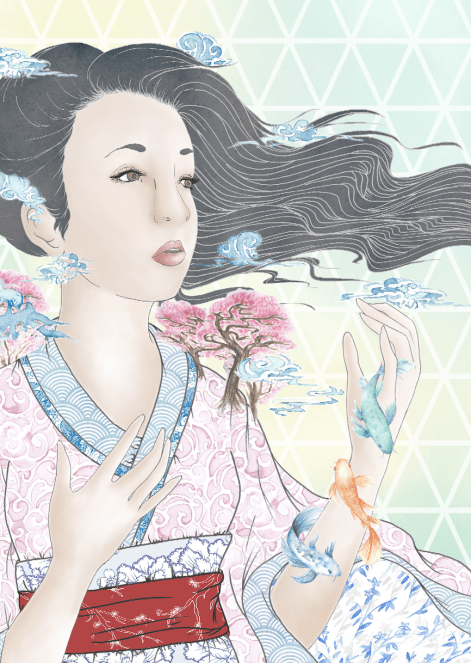
I think it’d be my Cheltenham Illustration Awards entry from 2017 (thus far)- it was a bit of a mixed process that culminated in a ton of stress, but it was worth it. I threw everything I’d ever learned at that piece, which sort of shows because it’s a bit ‘all over the place’, but strangely I think it ultimately works- at first I hated it!
Of course, there’s still a plethora of things I don’t like about it- always room for improvement.
Haru – Springtime (Collingwood, 2017)
What food, drink, song inspires you?
Coffee is the root of all creativity (jk)
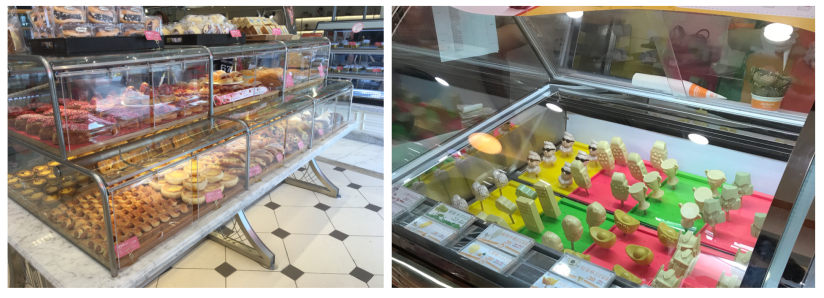
I’m not sure about being inspired by food? I think patisserie is really pretty though. I went to China in April of this year, and did a few little ‘Bake Off’-esque studies of the cute baked goodies they had there. There was lots of food shaped like other things… I even saw an ice cream shaped like Kim Jong-un ^^”
Baked goods and novelty ice cream in China~ (Collingwood, 2018)
Song-wise, I most like to listen to film soundtracks when working. Right now, my flavour of the month is the Call Me By Your Name (2017) score, which is lovely to work to. Because they are predominantly designed to be ‘background noise’ to accompany to what’s happening on screen, film scores are the perfect thing to passively listen to when creating.
Also, The Legend of Zelda soundtracks~
And songs with lyrics that I can’t quite make out (or even better, songs in foreign languages). I don’t know any of the words to most of my favourite music, but I like it that way. It’s nice to not have to know everything.
Is the artistic life lonely? What do you do to counteract it?
Honestly, I find solace in being alone. Not that I don’t like good company -I do-, it’s just that it’s often easier to organise my thoughts when I’m working by myself. I can’t even draw a straight line with someone looking over my shoulder!
In Western society, people seem to think of quietness as an undesirable trait- people favour extroverts. I feel quite strongly about this, maybe I’ll write a post in the future about it.
What do you dislike about the art world?
I think the current art climate is becoming all about politics; it’s OK to make things just for the sake of their beauty or design.
I admire people that can put a deeper meaning in their work, but there’s definitely room for artists who create for the sake of making something lovely. Art is a creative outlet that’s different for each person… it doesn’t always have to equate to something expected.
Lastly, when did you first develop a love for illustration?
As I said, I can’t remember a time when I wasn’t trying to draw or make something. I first gained a proper interest in art when I was doing fashion illustrations for my GCSE course- from there, I progressed onto Textile design (interiors, fabrics), and then finally illustration (which actually came from a last minute degree course change).
Also, once my art teacher told me my work was not fine art, as it was “too illustrative”.
Ha, this became a short essay! I know I won’t be able to help myself from expanding on some of these tangents in the future.
…And now we resume our scheduled program; worrying about the presentation!
References
Beckett, K. (n.d.). Kelsey Beckett Illustration – Gallery. [online] Kelseybeckett.com. Available at: http://kelseybeckett.com/# [Accessed 1 Oct. 2018].
Collingwood, C. (2018). Chinese Bakery [Photograph].
Collingwood, C. (2018). Chinese Novelty Ice Cream Shop [Photograph].
Collingwood, C. (2017). Haru- Springtime [Digital, various traditional techniques].
Before I start working on my Project Proposal treatment, I want to do a quick recap on what I’ve learned thus far, as well as planning out a Learning Guide for new skills throughout the coming year~
Overall Objectives
To summarise my design practice for this year, I’d like to expand upon my already existing skillset while also adopting some new techniques and workflows, such as risograph printing and furthering my digital prowess. To achieve these goals, I want to be able to utilise all the available valuable resources at the college, as well as return back to my roots with traditional and digital illustration.
Furthermore, I want to be able to develop my concepts this year to evoke deeper emotion and meaning- this could be through the usage of symbolism, emotive motifs, and other vehicles for portraying an idea through visuals.
Some of the most important areas I want to develop and improve throughout Year 3 include:
Concept Development
Visual Aid Research/Figural Drawing Improvement
Technique Refinement/Improvement of Rendering and Visualisation
Progression of Confidence and Personal Reflection Skills
Strengths and Weaknesses
While I anticipate that I’ll be able to help myself achieve these targets as I progress through the year by promoting a positive learning environment, I know there may be areas of weakness, as well as strengths.
For example, timekeeping is always an essential part of success, as bad timekeeping can have a massive impact on the quality of a project. I’ve identified this plenty of times in the past, but this is the big issue for me and I really want to work on improving my timeliness this year.
Another weakness is digital skills in programs such as Cinema4D and After Effects- I intend to produce an animated piece for a project in Semester 2 (STC), and this may very well see me having to make use of these programs. If I undertake the animation project as planned, I’ll endeavour to widen my skillset and broaden my understanding of digital animation programs as much as possible.
Moving onto strengths, I am quite proficient at creating pattern work and characters, as well as drawing upon many different work processes to create digital collages that utilise many different techniques (both digital and traditional). I love working on all of the above, so in order to balance out the struggles I might face during the Animation project, I’ll ensure to work on projects using these skills so I can showcase my most confident work, as well as continuing to build upon my skills and improve further.
Professional Development Plan
Skills, Knowledge and Experience– I’ve already outlined this above, but I anticipate that I’ll be able to include lots of skill and knowledge building in my projects, both through the revisitation of developed skillsets and by experimenting with new processes and workflows, particularly during Semester 1.
Processes and Methods– I am really looking forward to exploring risograph printing during Semester 1, with the possibility of extending this further into Semester 2 for additional project work if the outcome is desirable. Again, as previously mentioned I also want to continue to improve my existing digital skillset, as this is an imperative part of my creative practice and any improvement is welcome. As well as these physical work processes, I also want to improve my mental workflows which link to timekeeping and having a more positive outlook on my artistic journey as an illustrator.
Commercial Context– As far as industry progression goes, I’d love to flesh out my portfolio to be more in keeping with a certain art style and aesthetic- at the moment, my work is quite eclectic and while this isn’t really a bad thing, it’s still something that I need to bring together into a more cohesive look. For the future, my goals are to work freelance in various contexts that align with my personal tastes (although I realise this might not always be possible!), as well as continuing to develop my work to become more applicable to a variety of applications; while also maintaining a strong yet adaptable personal style.
Possible Collaborators– I already have some competitions/live briefs in mind that I would like to enter as part of the Commercial portions of both Semester 1 and 2- I’m hoping the Cheltenham Illustration Awards continues in 2019, as I throughly enjoyed working on this brief in 2017 for one of my final pieces. The Penguin Student Award is also on my radar, as I worked with book illustration during my time at CCAD last year and enjoyed the experience. Also, since I usually work alone as an artist, I’m looking forward to collaborating with the rest of my course for the final show, as portions of our show will be a group effort, e.g. marketing, branding, etc.
Possible Sources of Research– Throughout the year will include artist research, existing artwork research (for example, if working on a commercial project), and visual aid/reference research wherever appropriate in my project work. I will also research into deeper meaning and contextual study to support the progression of my concept building and symbolic deeper meaning in my work (as outlined in Overall Objectives).
Anticipated Problems/Specialist Access to Resources– Since some of my predicted projects include specialist equipment, I’ll need to make sure I plan in advance when I will be using these areas (e.g. the risograph room), as I’ll need to be mindful of other people booking sessions, particularly around hand-in where it might not be possible to choose an alternative day. Also, as I have already identified some of my potential threats/weaknesses in my workflow and skillset, I should be able to work proactively to avoid conflict and loss of morale when working on my projects.
With this information laid out, I’ll be able to make better decisions when writing out my Proposal and Treatment for the entire year. More updates soon! ♥
As an illustration student in my final year, I look forward to completing my studies while continuing to improve and broaden my artistic skill set. I chose to study illustration after finding an interest in textile and fashion design- I quickly realised I was more interested in the characters themselves rather than the garments and interiors/environments I was designing. This brought me into character design, which is one of my main areas of interest within the subject. I also enjoy working with pattern, as I have a fascination with repetition and organisation within visual design.
My work is quite feminine- I enjoy using flowing line and curves in my work, with a strong emphasis on female characters and figures. Natural influence is also a strong feature in my illustration, particularly in terms of pattern and environment. I love painterly textures and natural media, which I am continuing to explore and develop via both traditional and digital platforms.
Between now and October, I’d like to get back into illustrating after the long summer break, hopefully improving my understanding of form and colour while also learning new skills as I continue with my studies. I also would like to participate in a daily drawing challenge, as I’ve never managed to complete one of these!
Working towards these goals is really important to me, as I want to finish my degree with a strong understanding of every aspect of illustration, as well as a good work ethic and commitment to my practice. At the same time, I want to illustrate more ‘for fun’ than I have previously, where all of my work has been degree based.
 chalon joy collingwood