Late last week I was tasked with creating a set of ‘philosophies’ that define my practice as an illustrator. These can be about design narrative/context, visual aesthetics, workflow or personal preferences during the entire process.
This was much more challenging than it seemed- honestly I think I’m still building up to having a very distinct design aesthetic, but I definitely have a strong idea of what I want my work to portray in my head. The two don’t always come together in the final image (yet), but my process has a few unique facets to it that help me create my work.
The final list can be found here, as well as via the top menu bar: Info -> Design Philosophies.
Hopefully these shed some more light on my practice and design criteria, as I don’t often talk about it personally. I suppose that’s the point of a blog though~
As part of my ongoing effort to summarise my illustrative style, process and voice, I’ve created a little infographic about what goes into my creative workflow, and what comes out as a result- put simply, the ‘input and output’ of my process.
We were challenged to develop an infographic with a central theme that mirrors the information- I see my workflow as a growth process, so I chose a very organic looking theme for my image~ I see my workflow as an ‘ebb and flow’ type of process, in the same way that water ebbs and flows with the current. Check it out here, or under the menu bar: Info > Input and Output c:
Friday’s presentation is still looming on my mind- decided to do a little Q+A about my work to help take my mind off things…
Tell us a bit about your style!
Above all, I think my style is quite girly- I use a lot of traditionally ‘female’ imagery, ideas and shapes; curves and soft edges. I think there’s other certain themes that keep coming back in my work, too (flora and fauna, Asia-inspired imagery, patterns…)
Aside from that, I really don’t think I have a distinct ‘style’ per se, which does bother me a little bit. That’s definitely something I want to work on this year!
I remember reading a Q+A with illustrator Tony DiTerlizzi, whom said:
“…an artist’s “style” is simply an expression composed from a combination of the elements in other artist’s work that the artist finds appealing”. (DiTerlizzi, n.d.)
What inspires you?
Inspiration is literally everywhere (what a horribly cliché answer…)
I think mostly, my personal inspiration comes from travel, women, nature and cinema (in that order)
Artist-wise: Amy Sol, Claire Keane, Heikala, and James Jean are some of my favourites (more info in my references below!)
I also really love Space ♥
How do you know when a work is finished?
I don’t think a piece is ever really finished- at least not for me. I can nitpick my work to death no matter what stage it’s at, which can be both detrimental and helpful. I’m able to self-evaluate for the most part.
It’s all too easy to overwork a piece, but I’m starting to be able to tell when it’s time to step away. Usually though, I only overwork personal art- the timescales of academic projects mean there’s no time to overwork anything!
What is your most important artist tool? Is there something you can’t live without within your process?
I think there’s often a bad stigma surrounding digital processes- I still have a great appreciation for traditional work (as we all should), but the power of digital allows an artist to have more textures, brushes and media at their disposal than any traditional art setup.
I only started working digitally after A-Level (it was frowned upon by my teachers back then), and I’m so grateful to have been able to learn digital in such a short space of time- it’s been immeasurably helpful.
Is there an element of art you enjoy working with most? Why?
I LOVE pattern- I’ve always loved repetition for some reason! I find it very calming because it’s so organised, but not too orderly or mapped out. There’s room for variation in pattern; there’s an infinite amount of ways to repeat something.
I also love to include figures in my art, although to be honest I need to sharpen up my anatomical skills quite a bit before I’ll be able to fully realise what I’m envisioning in my head when it comes to figural work. More than anything, people can instantly feel emotion through human form; the pose, the expression, the surrounding imagery. Maybe it’s too literal, but it’s one of the easiest ways to connect with an audience.
How did you start making art? Why do you makeart?
I can’t remember a time when I didn’t want to create. I’m not much good at anything else.
Is there a piece you are most proud of? Why?
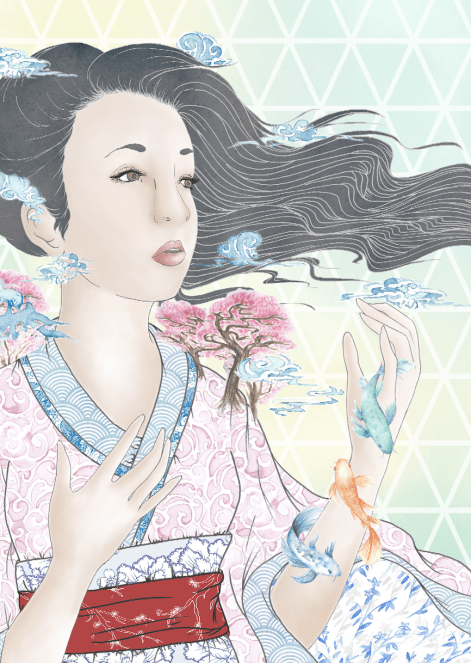
I think it’d be my Cheltenham Illustration Awards entry from 2017 (thus far)- it was a bit of a mixed process that culminated in a ton of stress, but it was worth it. I threw everything I’d ever learned at that piece, which sort of shows because it’s a bit ‘all over the place’, but strangely I think it ultimately works- at first I hated it!
Of course, there’s still a plethora of things I don’t like about it- always room for improvement.
Haru – Springtime (Collingwood, 2017)
What food, drink, song inspires you?
Coffee is the root of all creativity (jk)
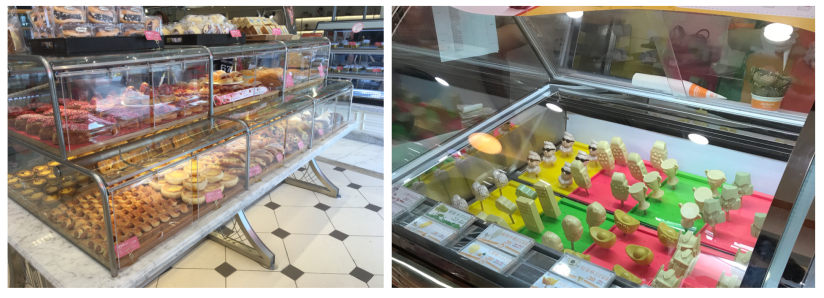
I’m not sure about being inspired by food? I think patisserie is really pretty though. I went to China in April of this year, and did a few little ‘Bake Off’-esque studies of the cute baked goodies they had there. There was lots of food shaped like other things… I even saw an ice cream shaped like Kim Jong-un ^^”
Baked goods and novelty ice cream in China~ (Collingwood, 2018)
Song-wise, I most like to listen to film soundtracks when working. Right now, my flavour of the month is the Call Me By Your Name (2017) score, which is lovely to work to. Because they are predominantly designed to be ‘background noise’ to accompany to what’s happening on screen, film scores are the perfect thing to passively listen to when creating.
Also, The Legend of Zelda soundtracks~
And songs with lyrics that I can’t quite make out (or even better, songs in foreign languages). I don’t know any of the words to most of my favourite music, but I like it that way. It’s nice to not have to know everything.
Is the artistic life lonely? What do you do to counteract it?
Honestly, I find solace in being alone. Not that I don’t like good company -I do-, it’s just that it’s often easier to organise my thoughts when I’m working by myself. I can’t even draw a straight line with someone looking over my shoulder!
In Western society, people seem to think of quietness as an undesirable trait- people favour extroverts. I feel quite strongly about this, maybe I’ll write a post in the future about it.
What do you dislike about the art world?
I think the current art climate is becoming all about politics; it’s OK to make things just for the sake of their beauty or design.
I admire people that can put a deeper meaning in their work, but there’s definitely room for artists who create for the sake of making something lovely. Art is a creative outlet that’s different for each person… it doesn’t always have to equate to something expected.
Lastly, when did you first develop a love for illustration?
As I said, I can’t remember a time when I wasn’t trying to draw or make something. I first gained a proper interest in art when I was doing fashion illustrations for my GCSE course- from there, I progressed onto Textile design (interiors, fabrics), and then finally illustration (which actually came from a last minute degree course change).
Also, once my art teacher told me my work was not fine art, as it was “too illustrative”.
Ha, this became a short essay! I know I won’t be able to help myself from expanding on some of these tangents in the future.
…And now we resume our scheduled program; worrying about the presentation!
References
Beckett, K. (n.d.). Kelsey Beckett Illustration – Gallery. [online] Kelseybeckett.com. Available at: http://kelseybeckett.com/# [Accessed 1 Oct. 2018].
Collingwood, C. (2018). Chinese Bakery [Photograph].
Collingwood, C. (2018). Chinese Novelty Ice Cream Shop [Photograph].
Collingwood, C. (2017). Haru- Springtime [Digital, various traditional techniques].
 chalon joy collingwood