
When exhibiting artwork (especially when the art is for sale), it’s important to consider new and interesting ways to add interest in order to capture the viewer’s attention, possibly increasing sales in an exceedingly competitive sector of the creative industry.
Of course, this isn’t from a purely business point of view, as the result must also compliment the artwork and be aesthetically pleasing. I love to add things on top of artwork, particularly runs of prints, as it adds a handmade touch that makes each piece unique.
Here are my 3 favourite ways to do this~
1- Surface Embellishment
I’m a big fan of glittery things- anything that sparkles or shifts in the light is sure to catch the eye of a bypasser, whether they like it or not! If the imagery is suited to it, adding a little bit of glitter or other embellishment can really make the difference between run of the mill art, and something people will buy.
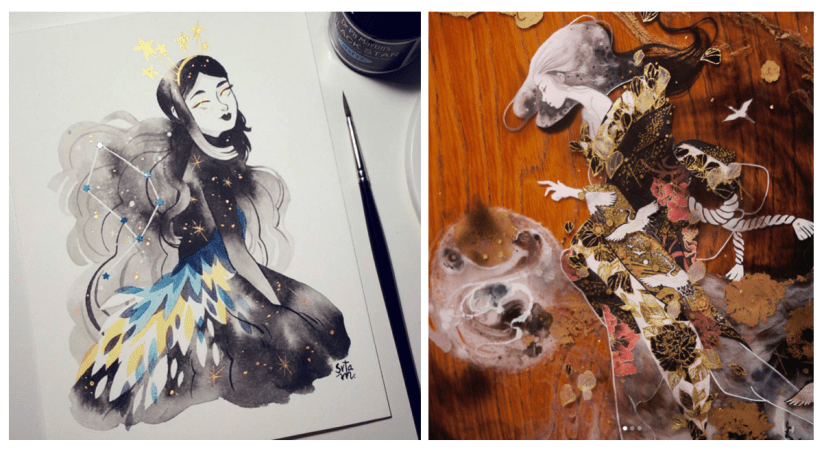
I bought a piece from one of my favourite artists (@m_atelier on Instagram, more info in my references), and she jazzed up the art with tiny star shaped sequins before mailing it to me. As it fit well with the other imagery in the work, it looked lovely and created a sense of personalisation and preciousness.
Another example of surface embellishment is using patterned paper or washi tape- @shardula uses this technique quite often, with gorgeous results that add detail and intricacy to the artwork. I suppose I use this technique myself in some of my artwork- I like to digitally overlay patterns as a replacement for colour (see the Artwork tab for examples of this), which is a similar process.
2- Metallic Overlays
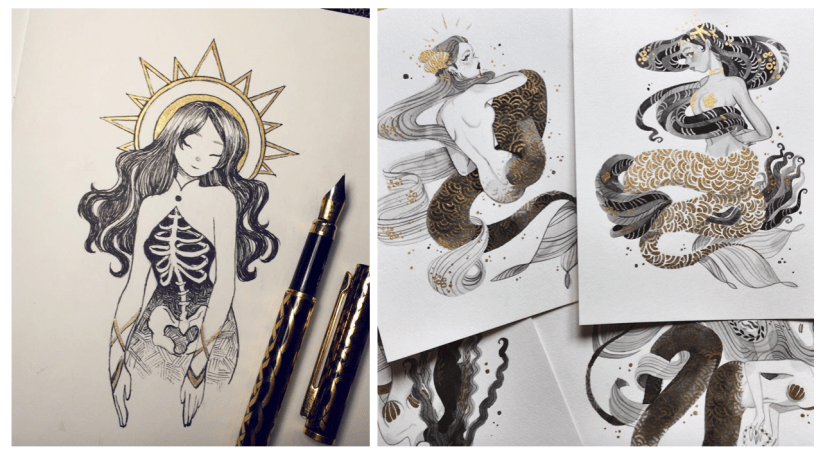
This form of embellishment can come from specially made inks or pens, as well as gold leaf or gold foils- each of these methods is best suited to different applications, so it’s up to you to find out which is best for your artwork. Foils can be added to fabric, which can add ‘a little something extra’ to screen printed tote bags or t-shirts, or they can be applied on top of prints using heat or screen-printed glue.
In terms of physical printed or traditional artwork, I find it best to use either pre-filled ink pens (my favourite is the Sakura Touch-Pen Fine, available here in all sorts of finishes), or nib-pens/fine brushes with inks such as the Winsor and Newton metallic calligraphy inks (link here), which are slightly more opaque and concentrated (but are a little harder to get the hang of).
Use metallic embellishment to add highlights or extra detail to the art- again, some of my favourite examples are from artists such as Sibylline Meynet (@sibylline_m) and Feefal (@feefal), shown below:
3- Proper Packaging
If the art is hand-pulled and won’t be produced again in the same format, you can market the pieces as a ‘limited run’ by numbering and signing them individually on the border of the art. Doing this adds value to the work, as numbered editions are considered the highest quality pieces from a run of prints (e.g. risograph, screen print, etc).
If art is being offered for sale, the general consensus is to sign numbered editions in the border of the art, and printed/mass produced prints inside the actual artwork (e.g. in the bottom corner of the piece, as long as it does not detract from the overall image). Always use pencil when numbering/signing artwork in the border, as this cannot be reproduced by printing!
By investing in some fitted cellophane bags, you can protect artwork from fingerprints or creases when selling, as well as add to the value. Mounting the artwork can also add to the overall appeal, as presentation of artwork is important when vying against competing illustrators. Additionally, including a business card with each print, or making a special branded stamp or sticker to seal the packet can add a sense of professionalism.
All of these techniques can help set your art apart from the rest aesthetically, as well as increasing value which in turn will allow you to make a little bit more profit on a piece.
I hope this was slightly helpful… of course the quality of the artwork is second to none when it comes to a successful illustrator, so consider this above all else ♥
References
Cass Art (n.d.). Winsor and Newton Ink [online]. Available at: https://www.cassart.co.uk/drawing/calligraphy/calligraphy_ink/winsor_newton_ink.htm?productid=1609&utm_source=google&utm_medium=base&gclid=EAIaIQobChMIlPOX15qM3wIVCEPTCh2__AkXEAQYAyABEgKbQPD_BwE [Accessed 3 Dec 2018].
Cult Pens (n.d.). Sakura Pen-Touch Fine. [online]. Available at: https://www.cultpens.com/i/q/SK21037/sakura-pen-touch-fine?gclid=EAIaIQobChMIoavCs5mM3wIVQeJ3Ch3cEgMdEAQYASABEgLa4fD_BwE [Accessed 3 Dec 2018].
Feefal. (n.d.). Instagram – @feefal [online]. Available at: https://www.instagram.com/feefal/ [Accessed 3 Dec 2018].
Feefal (2018). Untitled [Ink].
Licudine, M. (n.d.). Instagram – @shardula [online]. Available at: https://www.instagram.com/shardula/ [Accessed 3 Dec 2018].
Licudine, M. (2018). Golden [Mixed media].
Lopez, M. (n.d.) Instagram – @m_atelier [online]. Available at: https://www.instagram.com/m_atelier/ [Accessed 3 Dec 2018].
Lopez, M. (2017). Pavonis [Watercolour, ink].
Meynet, S. (n.d.). Instagram – @sibylline_m [online]. Available at: https://www.instagram.com/sibylline_m/ [Accessed 3 Dec 2018].
Meynet, S (2016). Mermay 2016 [Ink].
 chalon joy collingwood