portfolio

Concept Development – Storyboarding

Now that my character designs have been finalised, I can begin to storyboard the narrative.

While I do want the story to be interesting, I’m planning to make the main focus ‘interaction’- between the characters and their environments. This means a more gesture based approach to the animation, where characters will bond with their environments and explore new ones. In this case, the young girl will journey through her own woodland environment to the Deer’s house, where she’ll discover a new environment.

I’m most inspired by the way in which Studio Ghibli animates even the most mundane of actions with a quiet, curious interest- this is present throughout all of their films. It really brings out the natural beauty in the scenery without drawing the focus towards anything in particular.

The story is short (clocking in at just over a minute), but at an anticipated 12fps this should be more than enough to keep me busy!

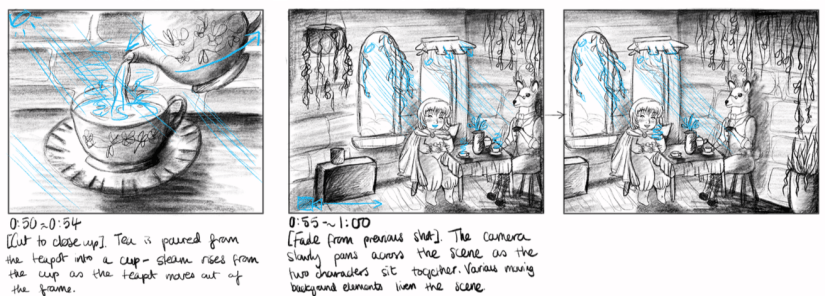
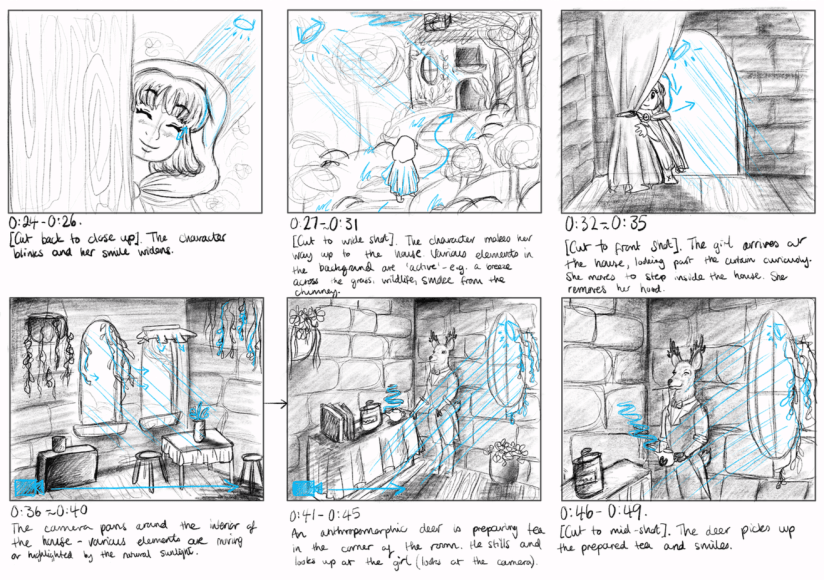
[Update 19.01.19] And here are my finished storyboards… I’m sure I’ll refine these more in future once I’m better informed with the limitations of the Semester 2 project, but for now these will do nicely. I had a few problems with drafting out proper perspective in such a simplified way, but these are not written in stone so I can definitely correct these little problems in future when I have more time to dedicate to properly exploring environment design~
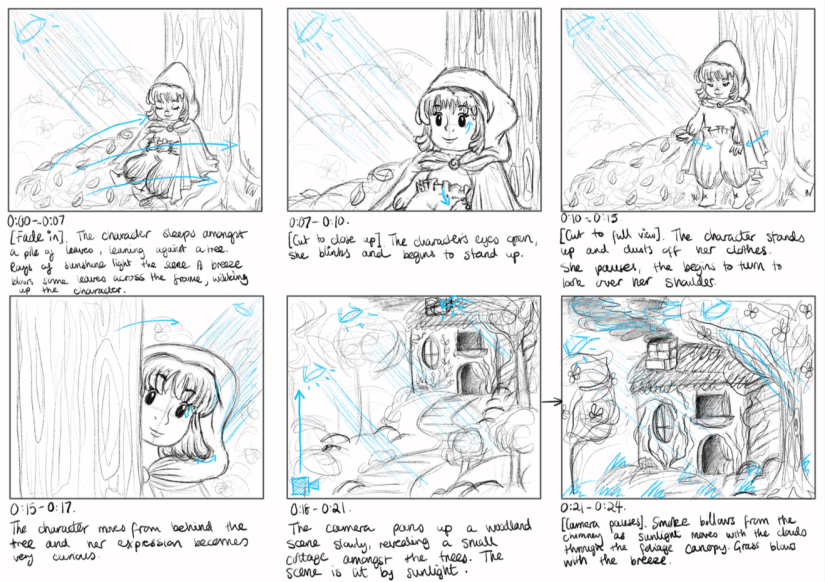
screen shot 2019-01-25 at 13.42.43screen-shot-2019-01-25-at-13.42.50.png

screen-shot-2019-01-25-at-13.42.58.png
Narrative Storyboards, PP2. (Collingwood, 2018)


I’ve really tried to look at how I can animate even the ‘still’ scenes, with background elements that move continuously or small pieces of animation to liven up an otherwise stagnant frame (e.g. the steam from the teacups, or the breeze blowing branches and leaves). I’ve used a blue pen to describe the animated aspects or camera directions- hopefully this will help me to clarify what to animate in each scene.

I’m overall pleased with how these have turned out, and even though there’s room for improvement this is my first experience with visual storyboarding. Can’t wait to get this project tied up and finished so I can start on Semester 2 work~


References

Collingwood, C. (2019). Personal Project 2 Narrative Storyboard Panels [Digital].
research

Concept Development Progress

Now that I’ve signed off the Penguin Student Award and Printmaking projects, I can finally dedicate my focus to the Concept Development project- I’ve already conducted a bit of artist research late last year (my post about it is here), so this has already given me a good foundation on which to design my concepts~

For this project, I need to produce as much development/concept material as possible for the upcoming Animation Production project in Semester 2. This includes character/environment designs, storyboards, narrative info, and other supporting material that will be of use to me in the coming months.

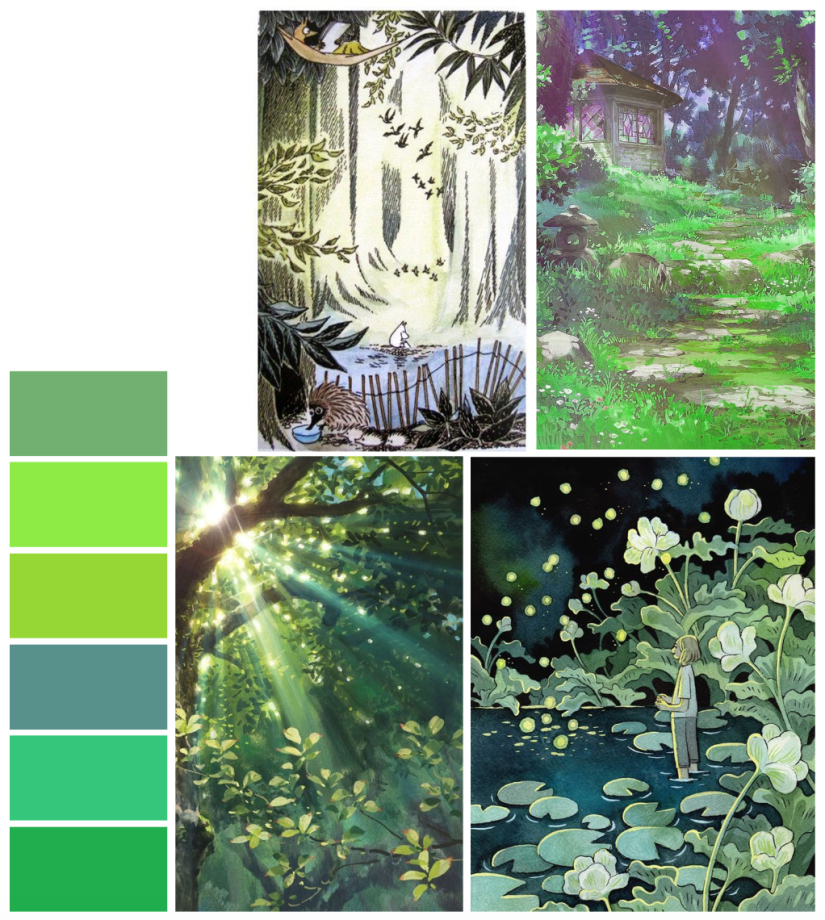
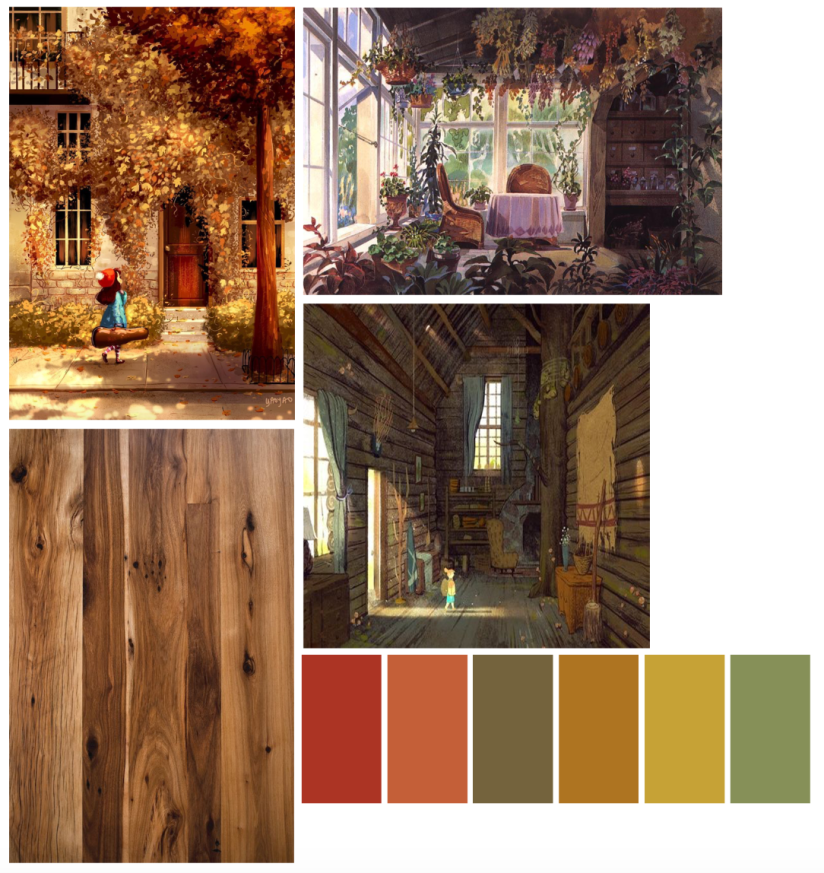
I’m starting with the character designs, since I feel that this aspect is the most important, and therefore want to get this done first. I’ll be designing a human young female character (who’ll serve as the centric narrative device), as well as a more visually intricate anthropomorphic deer, who’ll act as an ‘opposite’ character, with contrasting design aesthetics, environment and colour palette. I’ve made two concept boards with palettes and existing artwork that mirror what I want to portray for each of these two characters… a few pics below from each board (all referenced at the end of this post):

screen shot 2019-01-25 at 12.28.04
Top left: Figure a. Top right: Figure b. Bottom left: Figure c. Bottom right: Figure d.
screen shot 2019-01-25 at 12.27.14
Top left: Figure e. Top right: Figure f. Bottom left: Figure g. Bottom right: Figure h.

Using these images and palettes as a loose style guide will help me to design characters that will complement these visual concepts, while also using my notes on personality and traits that I’ve written up in my sketchbook.

I always find it useful to map out key persona information before designing my character, as I often have a good idea of how I want them to act before I bring them to life on paper- this allows me to incorporate design elements into their aesthetic that support their individual personalities.

I’ll post next week with some character development sketches ♥


References

h. Heikkala, L. (n.d.). Pond [Ink].

e. Jansson, T. (n.d.). The Moomins concept art [Graphite, watercolour].

a. Ma Van As, Y. (2018). After School Violin Lessons [Digital].

c. Mountain Lumber. (n.d.). Reclaimed Antique Hickory [Photograph]. Available at: http://www.mountainlumber.com/portfolio_page/reclaimed-antique-hickory/ [Accessed 1 Dec 2018].

d. Rockefeller, M. (n.d.). Paul’s Cabin [Digital].

f. Studio Ghibli. (2010). Concept art from The Borrower Arrietty [Watercolour].

g. Studio Ghibli. (2010). Screen capture from The Borrower Arrietty [Animated feature].

b. Studio Ghibli. (2010). Concept art from Kiki’s Delivery Service [Watercolour].

inspiration, research, SWOT/Target Setting

Concept Development – Project Beginnings

This new week means the start of a new project- quite the relief! As much as I enjoyed the riso project, it was very overwhelming learning literally an ENTIRELY new process, from the design basics to the niggly little details surrounding printing and technical issues. I’m not completely done with riso printing, however- I still hope to use it more actively in the new year, especially for print editions to sell at final show.

Onto the new project- Character and Narrative Development! As much as this represents its own set of experimental challenges, I’m hoping it’ll be a little more of a gradual learning curve, rather than the ‘throw myself in the deep end’ approach of the riso printing process ^^”

Thus far, I’m deep into the research portion of my workflow- since this project has been on my mind for a very long time (read: years), I already had quite a good vision of what the aesthetics of the environments and characters will look like. As such, my list of existing artist inspiration is long! To name a few, Nicole Gustafsson, Taryn Knight and Heikala are some of the most influential people I’ve looked at (examples of their work below.)

Screen Shot 2018-11-22 at 18.04.29.png
Left to right: Heikala, 2018. Gustafsson, 2018. Knight, 2018.

More on this in my artist research file, but I especially love Gustafsson’s work with anthropomorphic characters- this will be a big source of inspiration for my deer-man character. A similar simplified art style like Heikala’s work would work well for the animation, as I must always be mindful of the level of detail in the imagery- while I’ve timetabled quite a few weeks to realise the project, I don’t want to overwhelm myself with detail in the work.

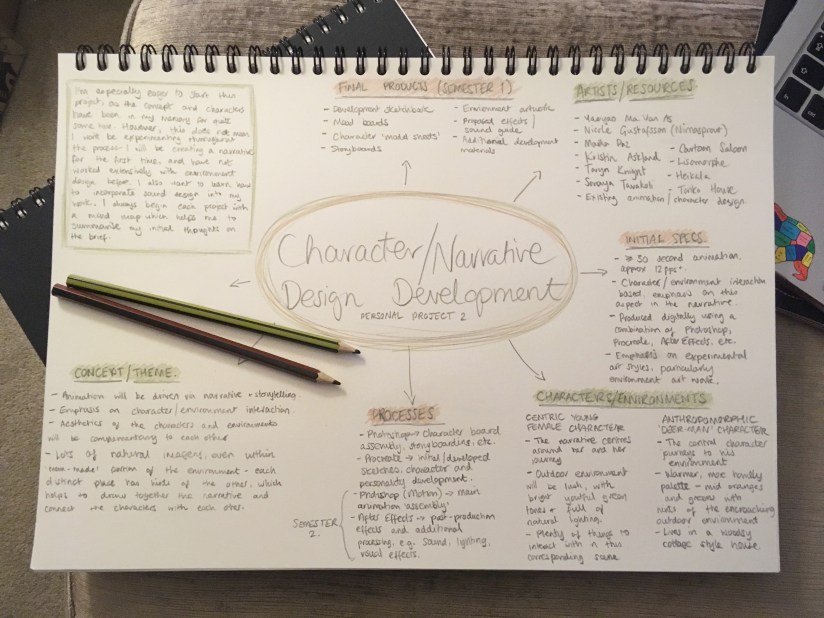
I want the piece to have a warm, familiar feel with a woodsy colour palette for the most part- with warmer, organic tones for the deer-man and more youthful, fresh colours for the centric female character. More details on character, aesthetic and the more technical side of my project are documented in my initial mind map:

IMG_7944.jpg
My initial mood board for the project- gathers all my thinkings into one place! (Collingwood, 2018).

For the rest of the week, I’m aiming to make some mood boards that can portray my intentions for aesthetic, colour and character design in a very strong way- I often struggle to find faith in my initial ideas, especially when pitching them to other people, so I’m hoping a few mood boards that are well put together will aid me from the outset. (…did I also mention that mood boards are an excellent prop to hide behind during formal presentations…?)

In addition, I often like to fully flesh out my characters with MBTI personalities and trait lists… all part of my process to feel more connected to my characters. This will be the main focus of next week.

More soon ♥


References

Collingwood, C. (2018). Personal Project 2: Initial Mind Map.

Gustafsson, N. (2018). Shiba Spellcaster [Acrylic].

Heikkala, L. (2018). Astrochemist [Ink].

Knight, T. (2018). Untitled [Watercolour].