portfolio

Risograph Realisation- Printing and Embellishment

First of all, sorry for the super long hiatus- between the Easter hols and life stuff in general, I’ve been busy sorting out various aspects of this project- it’s been a journey, but we made it!

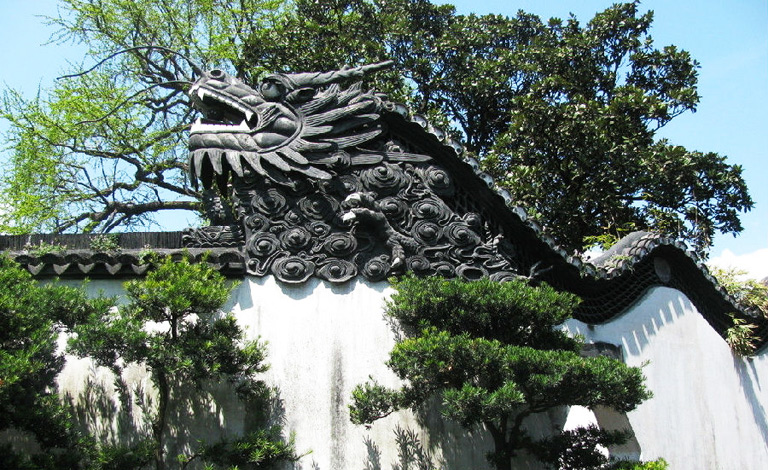
In terms of finalising the imagery for print production, I had a few issues with the Dragon image- when I’d first decided on the central elements of each print, I was acutely aware that if I didn’t execute it properly the Dragon image would be a bit… cheesy looking. Maybe it’s just my spin on things, but dragons are inherently a bit lame so I really had to work to make sure my print wasn’t typical/lame. I feel like it’s halfway in-between haha- not quite cringey, but also not really what I envisioned, which is a bit of a shame. I based the imagery off a decorative wall within the traditional Yuyuan Garden in Shanghai:
yu-garden-768(2)
‘Dragon Crossing the Clouds’ (China Discovery, n.d.)


I thought this was a really unique part of the architecture within the garden, and this helped me immensely while I was designing this part of the imagery ❀

The koi, as previously noted in my Durham University visit posts (here and here), was influenced by reference imagery taken during my outing. This was the easier of the two prints to design, as the subject matter lends itself towards the type of aesthetic I was going for~


I won’t document the actual printing process here (more info in my research folder) as that’s already been covered on this blog here, but my final two designs turned out much nicer than expected! The new ink colours really helped too, as I was able to use a much cooler, less harsh palette of blue, teal and purple. I really knocked down the opacities on all four layers, which produced a lovely painterly effect…

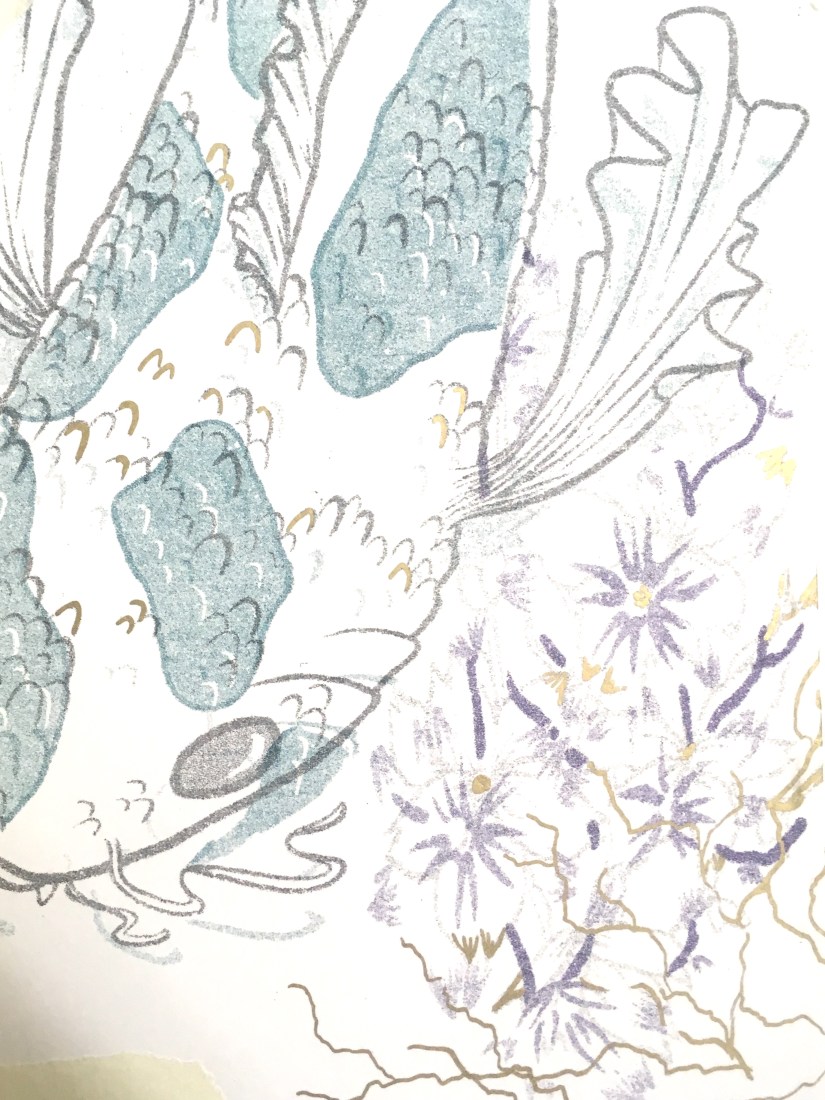
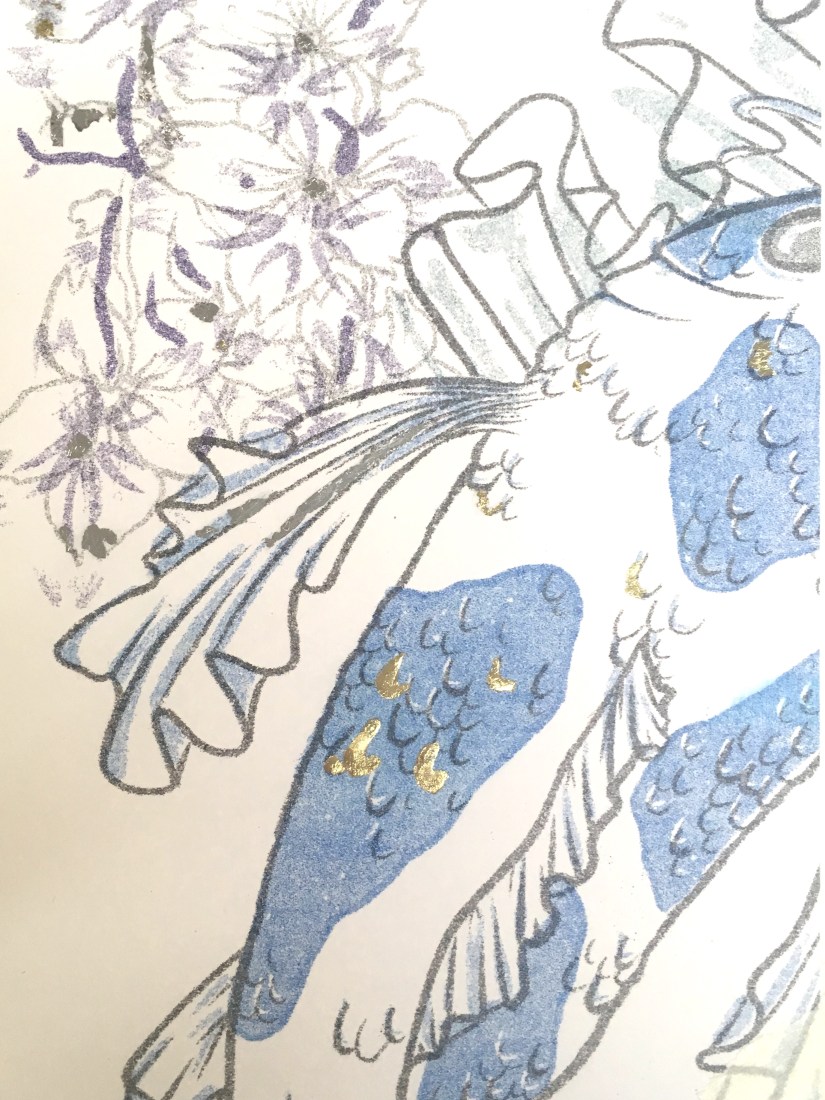
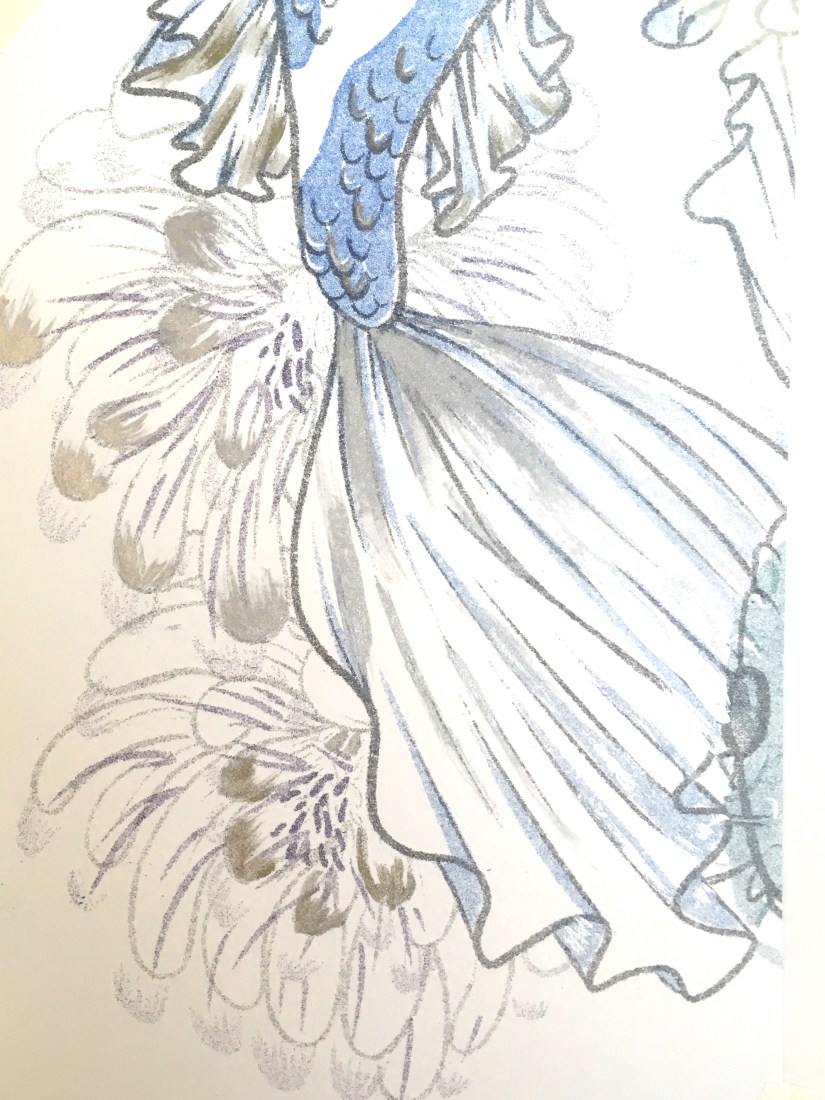
…in fact, the resulting imagery was so nicely processed that I didn’t even want to embellish on top of these! I did some tests with metallic inks, pens and foil leaf on a failed print from my first printing attempt, and honestly the results were nice, but didn’t enhance the prints at all. The embellishment appeared very heavy compared to the plain prints, so I decided to ultimately leave this part of my proposed process out, since I felt it detracted from the final product too much. That’s not to say I regret researching into this so much- I can undoubtedly use these techniques in the near future, as I plan to work with printmaking often once I graduate.
IMG_9864
Risograph Embellishment: Gold Leaf Test (Collingwood, 2019)
IMG_9865
Risograph Embellishment: Metallic Ink Test (Collingwood, 2019)
IMG_9866
Risograph Embellishment: Metallic Pen Test (Collingwood, 2019)

Targets for the coming weeks include… doing the entire Cheltenham Awards project because I’ve left it so late! As well as continuing to build and collate my portfolio ready for hand in ♥

More in a few weeks once I’ve made a good start on the next project!


References 

China Discovery (n.d.). Yuyuan Garden: ‘Dragon Crossing the Clouds’ [photograph]. Available at: https://www.chinadiscovery.com/shanghai/yu-garden.html [Accessed 12 Apr 2019].

Collingwood, C. (2019). Chinese Dragon Risograph Print [risograph print].

Collingwood, C. (2019). Japanese Koi Risograph Print [risograph print].

Collingwood, C. (2019). Risograph Embellishment: Gold Leaf Test [risograph print, gold and silver leaf].

Collingwood, C. (2019). Risograph Embellishment: Metallic Ink Test [risograph print, metallic inks].

Collingwood, C. (2019). Risograph Embellishment: Metallic Pen Test [risograph print, metallic pen].
portfolio, research, SWOT/Target Setting

Risograph Realisation – Idea Finalisation

It’s been a bit of a weird week- I haven’t made as much progress as I’d hoped with this riso project but any progress is better than none at all! ♥

I’ve been looking at finalising my riso ideas, and while these are still fairly rough drafts I find it much easier to visualise a final concept in a neater, tidier visual style (e.g. I’ll be really finishing up the layout in the actual final piece process, which is much easier thanks to the flexibility of Procreate).

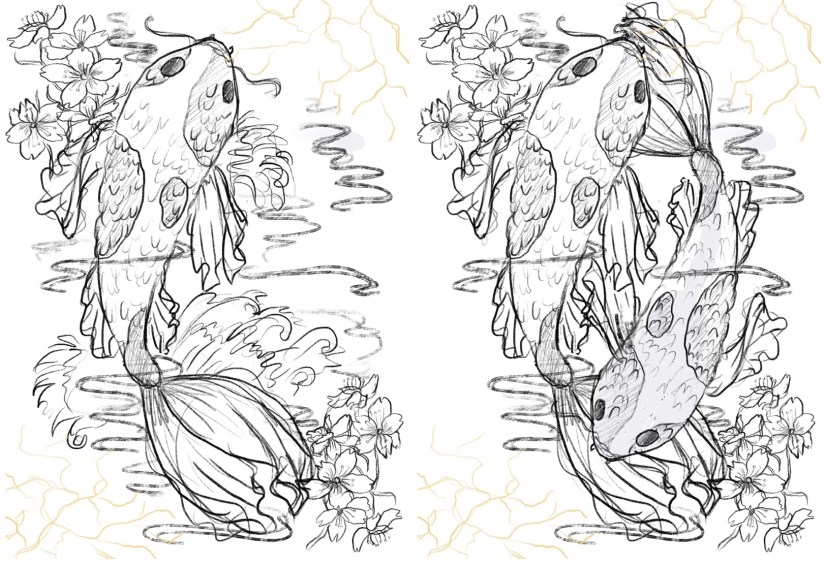
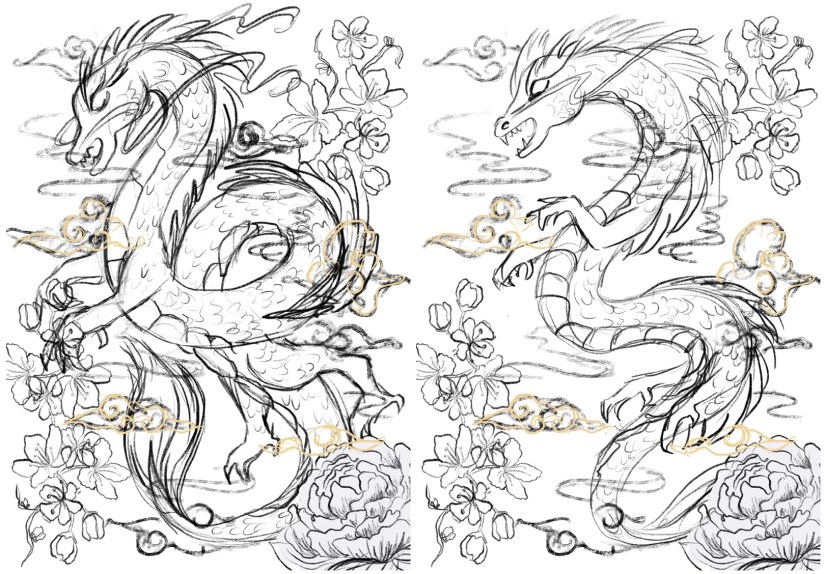
So far, I’ve got 4 potential ‘final’ layouts, each with differences that affect the way in which the artwork fills out the frame of the piece- since these will be A3, the actual image will be slightly smaller on each side (~2.5cm) due to the riso printing limitation. I’ve also begun to visualise how I can embellish these pieces (see the light gold coloured overlay on each piece for ideas on which areas I might work into- this is all TBC!).

China Risograph Print Final Concepts (Collingwood, 2019)


Japan Risograph Print Final Concepts (Collingwood, 2019)


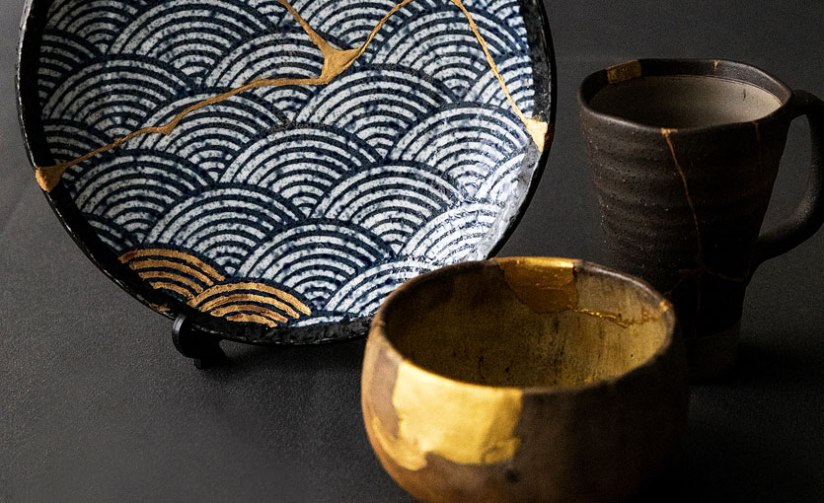
One technique I thought would work especially well on the Japanese/Koi Fish print was kintsugi inspired embellishment (which I’ve begun to visualise in the final concept sketches). I came across this art form during my visit to the Durham University Oriental Museum, where there were examples of ceramics displayed utilising this technique. The result was beautiful, and the idea behind the process even more so.

Kintsugi is based around the idea that the imperfect is beautiful- while some of us in the Western world prefer things to be new, Japanese people relish repairing broken items and seeing beauty in imperfection. This also links to the wabi-sabi philosophy, which centres around the idea that imperfection and the transience and fragility of perfection is accepted- far different to the obsession with perfection we have in the West.

I’d love to incorporate this into my work, as I too have a fascination with perfect things- I think it’d add some nice little imperfections into my pieces. The fact that I’ll be embellishing these by hand will mimic the original technique; the rest of the imagery will be digitally produced and collated, printing using the risograph which is very ‘perfect’ despite some natural variance in the process.

Hero
Kintsugi – Japanese Ceramic Gold Repair (Sydney Community College, n.d.)


I’ve also started to look at colour palettes and application for the final riso prints- since my palette is somewhat limited, I need to use my trusty Risotto colour swatch pack to look at alternative palettes that would work well. Since my artwork is mostly line-art based, I can use quite dark shades of the inks to intensify the line work while employing lighter, more subtle shades to add interest and shading.

This will be a target for the coming weeks after I’ve finished the base artwork- I’ll use Photoshop to manipulate the grayscale layers to view different colour palettes, which I’ll write about in my sketchbook.

I can’t wait to start properly visualising these finals… I’ll be using Procreate to render and layer my files ready for printmaking~

Blog post on this process coming soon! ❀


References

Carnazzi, S. (n.d.). Kintsugi: the art of precious scars [online]. Available at: https://www.lifegate.com/people/lifestyle/kintsugi  [Accessed 21 Mar 2019].

Collingwood, C. (2019). China Risograph Print Final Concepts [digital].

Collingwood, C. (2019). Japan Risograph Print Final Concepts [digital].

Richardson, J. (2016). WABI-SABI and UNDERSTANDING JAPAN | A PHILOSOPHY AND AESTHETIC AS WORLDVIEW [online]. Available at: https://www.tofugu.com/japan/wabi-sabi/ %5BAccessed 21 Mar 2019]. 

Sydney Community College. (n.d.). Kintsugi – Japanese Ceramic Gold Repair [photograph]. Available at: https://www.sydneycommunitycollege.edu.au/course/kintsugi.gold.repair  [Accessed 21 Mar 2019].

evaluation, SWOT/Target Setting

March 2019 – Progress and Reflection

It’s been a week or so since my visit to the museum, and I feel that despite always feeling that I’ve never done enough work (this is probably part *actual* truth and part self belief issues haha), I’m happy that I’ve managed to nail down my final concept after a series of initial and developed designs.

I think this riso project dragged a bit for the first couple of weeks- I suspect this is due to the fact that I spent a lot of time researching into the imagery that I wanted to use. I’m very aware of this subject matter potentially walking a fine line between appreciation and appropriation, so I wanted to take the extra steps to ensure I was representing each culture accurately. I also made use of my current knowledge as I do have a strong general interest in this topic, but I’ve learned so much more through thorough research. It’s always better to be safe than sorry, and I’m pleased that I was also able to expand my research file with this~

Drawing out the initials is really tedious for me- I much prefer sketching out the development, since this is building on an idea I really want to do (rather than drawing out ‘filler’ ideas). I fully admit I usually have a somewhat fully formed initial idea in my head when I start a project, so it can be hard to stray from this or try to show enthusiasm for the other initial ideas ^^”

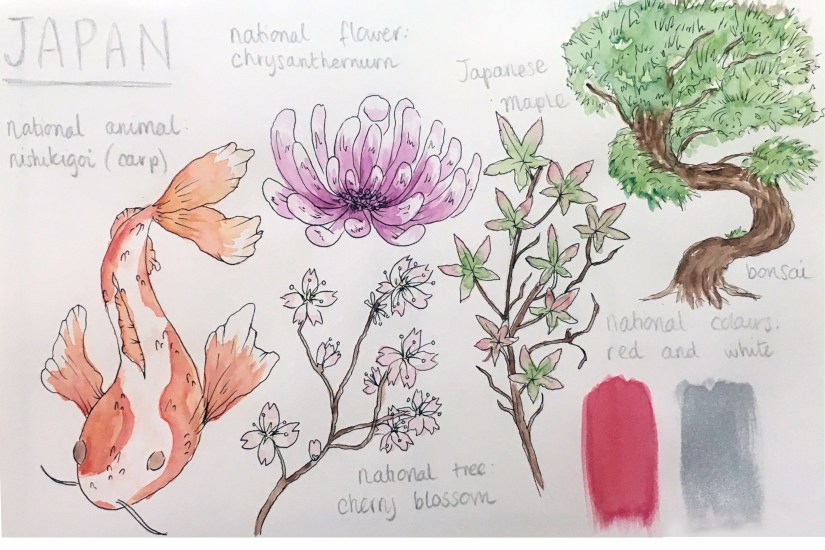
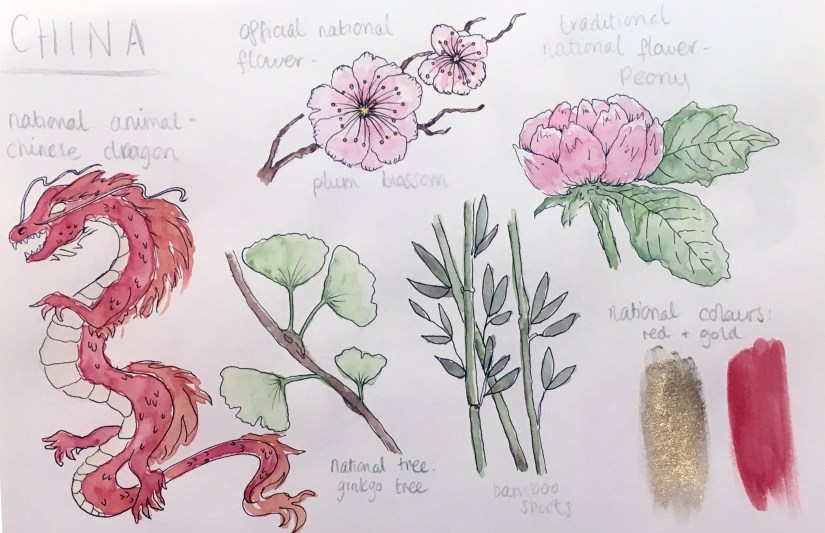
Another thing I really wished I’d done was to do all of my initials and development digitally- as well as aiding in the general layout, working digitally is much neater and less messy than scribbly pencil drawings (which my sketchbooks are notorious for). I tried to remedy this by doing a few little ‘key icons’ research pages in watercolour in my sketchbook- the phrase “you can’t polish a turd” comes to mind, but I had fun doing them anyway!

japaniconsheet
Japan Icon Sheet (Collingwood, 2019)


chinaiconsheet
China Icon Sheet (Collingwood, 2019)


It was really strange drawing and colouring something refined traditionally- I never thought it would come to this but I actually really prefer digital now! Especially since I’ve started working on Procreate with my iPad, since the technicality and effects both mimic tradition workflows very well. Throwback to the iPad review I wrote- read it here

Targets for the coming weeks include finishing off my digitised concepts, taking these into the final design stages, and looking further into colour choices with the riso.

I’ll have to be mindful of any threats to my progress such as time restraints and poor planning, as these things have hindered me in the past- however, I’m determined to keep better time this semester, as one of my targets from a few weeks ago was to manage time better.

More to come soon!


References 

Collingwood, C. (2019). China Icon Sheet [ink, watercolour].

Collingwood, C. (2019). Japan Icon Sheet [ink, watercolour].

research

Durham University: Botanic Garden Visit

As part of my ongoing effort to source primary reference sources (this was a weakness in my workflow during Semester 1), I’ve been for a visit to the local Botanical Garden and the Oriental Museum, both of which are kept my Durham University. To prevent this from being overly wordy I’ll just talk about the Garden today, but I’ll be sure to make a post on the Oriental Museum in the future as both were fantastic!

In an attempt to catch some nice weather for the first part of the trip, we visited the Gardens first- of course, this was a failure because when do we ever have nice weather in the UK? It was really misty and since it’s still February, there wasn’t much to see in terms of flowers and blooms. I did spot a few British flowers planted at the front, but since my project is based on Asian flora, this wasn’t applicable to my area of research.

My favourite area of the garden is the collection of greenhouses, which contain ‘exotic’ plants that aren’t native to the UK. This is where I collected most of my references of succulents for my terrarium project, and at a slower pace I was able to discover some really nice plants that I could reference for this project.

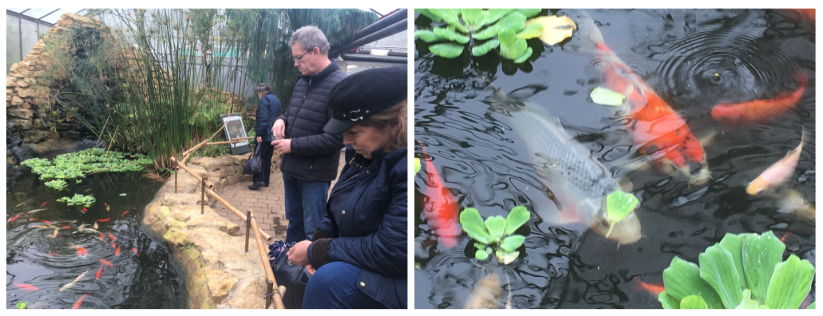
I also discovered another gem in the back conservatory of the greenhouse- koi fish! I hadn’t noticed these at all the first time I went in (I was in a pretty urgent hurry), so I took some time taking reference images of these fish. Here’s a pic of me employing my family to bait the fish with feed while I took photos haha:

Screen Shot 2019-03-01 at 13.03.07
Durham University Botanic Garden: Feeding the Koi/Koi Fish (Collingwood, 2019)

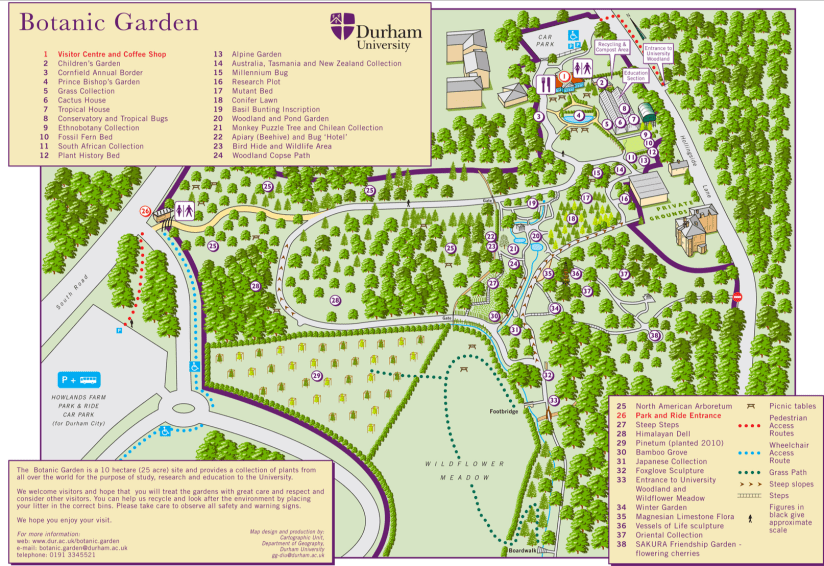
After having a good mooch through the tropical section, we ventured outside to the main garden. Looking at the map, there was a cluster of areas that interested me; the Bamboo Grove (30), the Japanese Collection (31), the Oriental Collection (37), and the Sakura Friendship Garden (38)- see these on the map below:

Screen Shot 2019-03-01 at 13.31.20
Botanic Garden Visitor Map (Durham University, n.d.)

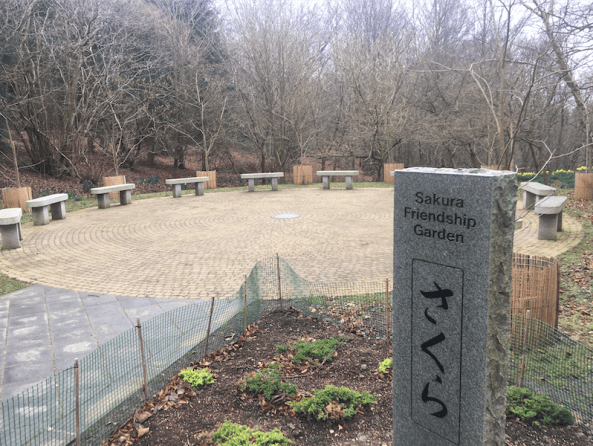
It was quite a trek, and when we arrived at the Oriental Collection there wasn’t too much to see- mostly trees and the odd leafy plant, but compared to the variety in the greenhouses it was a wee bit disappointing. Since it’s out of season, the Sakura Friendship Garden was also a bit underwhelming. Now obviously this garden doesn’t focus on flowering plants nor are they in season, so I sort of expected it to be limited- however, this is the best selection that’s accessible to me, so it’ll have to do for now~

Screen Shot 2019-03-01 at 14.06.28
Durham University Botanic Garden: SAKURA Friendship Garden (Collingwood, 2019)

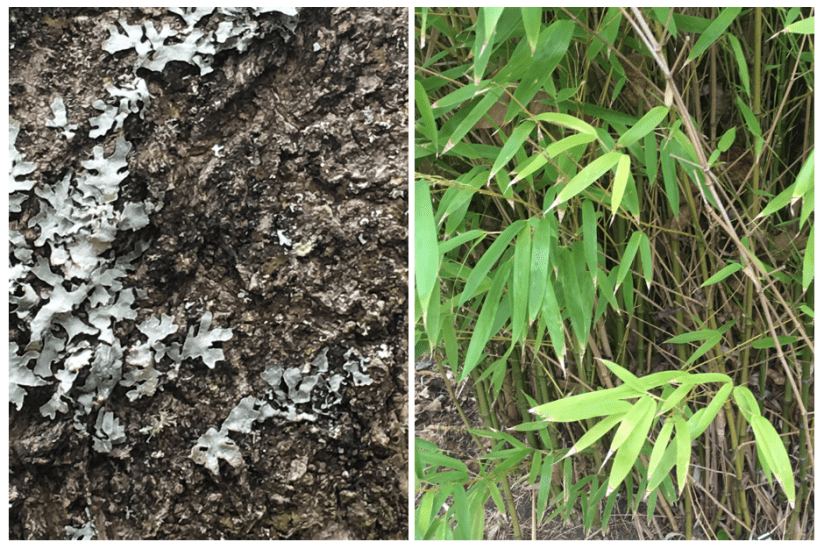
On the plus side, I really enjoyed the Bamboo Grove! Plenty of mossy textures and interesting leaves and branches to photograph- these will definitely come in handy.

Screen Shot 2019-03-01 at 13.47.46
Durham University Botanic Garden: Moss Specimen/Lostachys Aurea (Collingwood, 2019)

Despite the drawbacks, I really loved this garden- I’ve re-visited it quite often for inspiration and reference, the most recent being for my first experimental risograph project during Semester 1. That was a bit of a whirlwind visit since time was very short, but I was able to enjoy it much more this time around (despite there still being fairly little flora outside of the nice warm greenhouses!)

More in the next few days on the second leg of our trip- the Oriental Museum c:

[Edit 27th Feb: Oriental Museum trip report here!]


References

Collingwood, C. (2019). Durham University Botanic Garden: Feeding the Koi [photograph].

Collingwood, C. (2019). Durham University Botanic Garden: Koi Fish [photograph].

Collingwood, C. (2019). Durham University Botanic Garden: Lostachys Aurea [photograph].

Collingwood, C. (2019). Durham University Botanic Garden: SAKURA Friendship Garden [photograph].

Collingwood, C. (2019). Durham University Botanic Garden: Unidentified Moss Specimen [photograph].

Durham University (n.d.). Botanic Garden Visitor Map [map]. Available at: https://www.dur.ac.uk/resources/visitor-attractions/Botanic_Garden/Durham_University_Botanic_Garden_Map.pdf  [Accessed 20 Feb 2019].

research, SWOT/Target Setting

Risograph Realisation – Design Development

In my initial ideas, I’ve played with concepts such as traditional Asian-inspired pattern work (which I’m quite familiar with from past projects), basic floral motif work, and my favourite concept so far: prints based on national imagery associated with Japan and China.

I visited China last year and -for lack of a less cliché term- fell in love with how cultural significance is interwoven throughout every aspect of their design and aesthetic. The concept of a pair of prints representing China and Japan came from the idea of ‘where I’ve travelled to, and where I plan to go next’, combined with a deep appreciation of Asian culture and design. Since the two cultures influenced each other so much throughout history, a pair of prints encapsulating each country’s defining aesthetics works really well (both as an entity and as separate pieces of design).

After working on this idea, I was enjoying some down time in front of the telly and caught an episode of Monty Don’s Japanese Gardens (BBC Two, 2019)- obviously this appealed to me massively! The pair of episodes focused on the distinct seasons of spring and autumn in Japan, and how the foliage and flora changes accordingly. Of course, this inspired an alternative to my front-running design idea based on this aspect of Japanese culture and aesthetic design- nothing is by chance in Japanese design, not even nature!

Additionally, since the risograph printer is originally from Japan I thought it would be really interesting to combine traditional Japanese imagery with the newer technique of riso printing to create something that bridges the gap between traditional and modern technique.

I also really want to explore colour in this project, since we have some lovely new inks to use in this process (these being Purple, Teal and Green). I see lots of opportunity to incorporate these shades into my work to create something more refined and less blocky and loud compared to the terrarium project, which was printed in garish tones of blue and pink. I still like those prints, but I’m hoping to capture a totally different and more refined aesthetic with this project that’s also more visually in-line with other projects I’ve worked on.

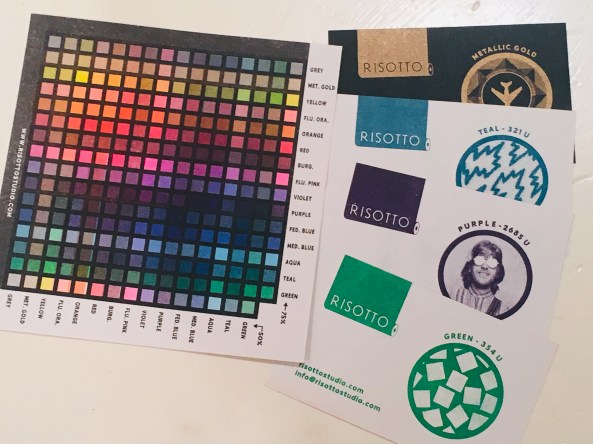
To help me with colour matching, I’ve ordered a riso swatch pack from Risotto (a print studio based in Scotland that I’ve included in my research)- since it’s not very cost effective to make a test sheet of colour overlays and combinations myself, I thought I’d order a pack from a riso studio to use as a guide when fiddling with the opacities of my final image. I didn’t really make use of this design mechanic in Semester 1, so that’s a personal goal of mine for this project c:

IMG_8566
Risotto Studio Risograph ink swatches (Collingwood, 2019)


Here’s a pic of the contents of the pack- looking at these, I really wish we had a gold ink available at the college! It looks especially nice on black ♥ I’m still planning to embellish my final prints in ‘post-production’ using a variety of techniques- maybe even making some of them specific to a particular print. This will include metallic leaf work, so I can make a similar effect myself for now.

In terms of SWOT analysis for this week, I can work with my previous analysis from Semester 1’s PP1 (Printmaking), when I was also working on a riso project. Despite having more strengths with the riso medium than weaknesses due to valuable past experience, I still need to be aware of my biggest threat: timekeeping. However, the best opportunity for this semester will be to *actually* keep better time throughout, which is very doable since I’m still pretty early on in the term.

More next week when I nail down my final idea (I’m still a bit undecided!) and start refining this digitally~


References

Collingwood, C. (2019). Risotto Studio Swatch Pack. [Photograph].

Monty Don’s Japanese Gardens. (2019). BBC Two Television, 15 February.

Risotto Studio. (n.d.) Risotto Riso Room. [online]. RisottoStudio.com. Available at: https://www.risottostudio.com/print [Accessed 3 Feb 2019].


research

Commercial Project 2 – Risograph Realisation

There’s only 3-ish weeks until the release of the Cheltenham Illustration Awards theme and the start of the Call for Entries, so I’m coming back to the lovely process of risograph printing for a short and sweet 4 week project to fill my time until then~

This time around I already have a  good knowledge of the process and what it entails, as well as what types of artwork are best suited to the unique qualities of the risograph printer.

Since it’s quite an uncommon facility, I really want to make the most of my access to the riso this year while at college- there are other companies who print risographs to order (e.g. Risotto Studio, more on this later in my research) but these are few and far between and there’s nothing better than going through and learning the process yourself!

Armed with this prior experience, I’ll be able to produce much more refined prints that make better use of colour (including the new inks!!), as well as transparency/opacity levels and layout (e.g. line trapping, negative space, etc).

As always, I’ve begun the project with a mind map encompassing all of my ideas, areas for research and outcomes, as well as a rough workflow outline:

IMG_8962

Before mapping out my ideas, I also wrote a little synopsis of the project and what the aims are- might as well post below!~

Project Synopsis

  • For this project, I want to directly follow on from my initial risography experimentation in Semester 1, utilising my newfound skills, prior experience and increased colour availability to create a complementary pair of two prints. I will produce approx. 10 completed prints per image in a variety of finishes.
  • This pair of prints will be a continuation of the theme ‘Natural Pattern’, which I first explored in the experimental Printmaking project during Semester 1. I want to explore further natural subjects in these prints, merging together figure and flora/other naturally occurring elements, grouping these assets into themed outcomes that work well both individually and as a pair of complementary pieces.
  • I will be producing the imagery using Procreate, with additional hand applied processes such as metallic embellishment (e.g. hand-painted or screen printed, gold/silver leaf application) on select prints to add interest and unique elements. 
  • Ultimately, I’ll be aiming for the final prints to be of a good enough quality to be sold at my final show, in addition to being included in my portfolio as part of Personal Project 3 (PP3). 
  • I will also conduct thorough research before starting on my project as well as throughout the design process. This will include primary references, existing example research, risograph colour methods and printing applications, with additional visual development presented in an A4 sketchbook. 

As mentioned, I really want to make some nice prints to sell at final show- so this run of prints will be pretty commercial based rather than conceptual in order to meet the needs of the brief.

Targets for the coming week include starting to draw out some concepts (and finding/photographing references to go with these), as well as artist and existing imagery research. More next week! ♥


References

Risotto Studio (2019). Risotto Riso Room [online]. Available at: https://www.risottostudio.com/print  [Accessed 3 Feb 2019].

evaluation

Mini Riso- ‘Minerals’ Photography Print / Project Evaluation

Alongside my work for the Penguin Award and the Animation Development projects, I’ve been making a smaller ‘mini’ A4 risograph image, this time making use of photographic elements instead of illustration, as this is something I didn’t get to experiment with when I made my terrarium prints.

I’d originally intended to use my own photography for this side-project, but Royal Mail had other plans since all the rock minerals I’d ordered to photograph haven’t arrived… :c So purely for the purpose of experimentation, I’ve collaged together some royalty-free images (which are all referenced in my project development file) to use as a experiment- I’ll most likely be able to take my own imagery in the future to use for photographic risograph work, as I don’t want to include something in my portfolio that isn’t entirely self-produced. I collaged the images together quickly in Photoshop- I used my notes from my development work as a set of ‘rules’ when laying out the photographs.

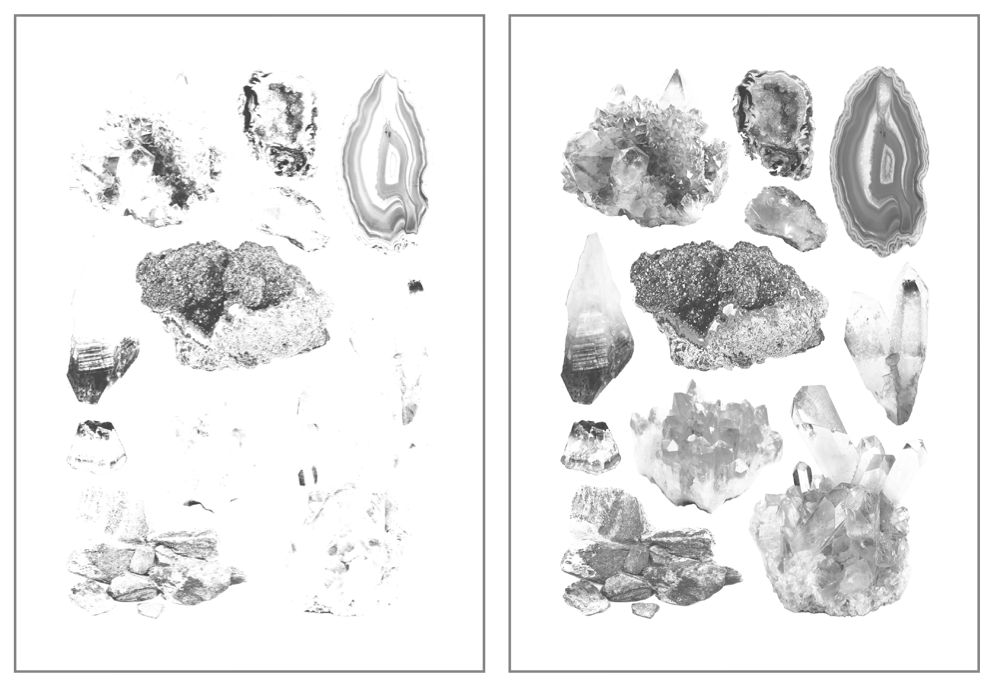
Once this was ready, I converted the image to black and white and duplicated the layer, one of which I edited using various Adjustment tools- I heightened the contrast and brightened up the second/upper layer, which meant only the darkest tones made it through into the final image- I’ll print this in the blue ink we have for the riso, with the base layer (with a wider range of light and mid-tones) printed in pink. Based on past experience with the riso during my terrarium printing run, I’ll be editing these on the riso prior to printing, bringing the ink coverage down to around 15-20%, as I don’t want bright colours on this print. The pink is extremely bright, and the blue extremely dark- hopefully reducing the coverage down to practically nothing will solve the problem. Below is my two final layers, ready for printing:

Screen Shot 2018-12-14 at 10.58.28.png
 Mini Minerals Riso – Printing Layers (Collingwood, 2018)


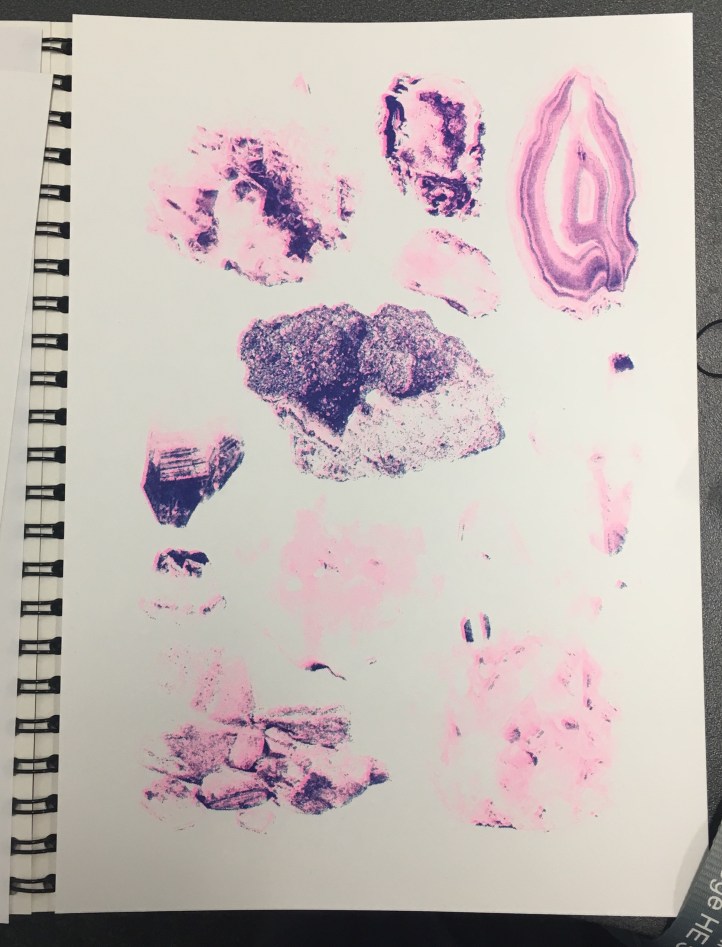
Obviously the printing process was much the same as the terrarium prints (again, all of this is documented much more in-depth in my development file), but this time I added halftones (via the riso)… and it worked well! Except that all of my prints were too light, haha. I initially thought that I’d need to make the masters super light to combat the really pigmented inks, but I think I went too far the other way, as lots of detail was lost in the final prints:

IMG_8117.jpg
My final prints- not quite to plan, but still a success experiment-wise! (Collingwood, 2018)

But, not to worry… this was a purely experimental exercise- when I’m able to take my own pics I’ll run some more prints off again, keeping in mind everything I learned throughout this test. I enjoyed the process anyway, and there’s no improvement to be gained unless you fail first!

Reflecting on the project as a whole… I’m glad I got to use the risograph printer, since it’s a process I’ve been interested in since hearing about it just over a year ago. It’s certainly been unconventional for me, since the colours are so restricted (and BRIGHT!), as well as the digital process involved in making artwork riso-ready. It was really nice to try out new techniques and styles of artwork all in the name of suitability, since prior to this I’ve been quite stuck in my ways. I’d love to revisit this in the future, but for now it’s definitely high time to start on the next Semester 1 projects…

Onwards and upwards c:


References

Collingwood, C. (2018). Mini Minerals Riso- Printing Layers 1 and 2 [Digital].

Collingwood, C. (2018). Mini Minerals Riso- Final Print [Risograph Print].

evaluation

Risograph Printing / Weekly Reflection 3.12.18

After a myriad of issues that got in the way of this project, I was finally able to print some risograph images today~

First, I’ll recap the prepping process for the imagery:

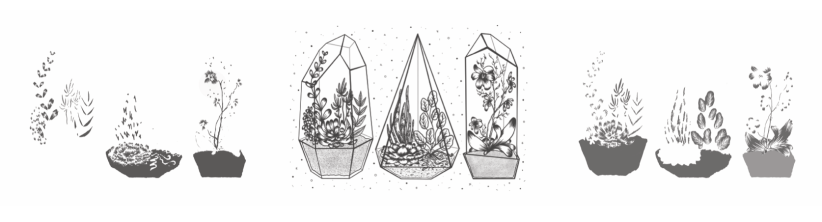
Once I had the line art drawn out (done on Procreate, which I’m slowly getting the hang of), I began to apply colour on separate layers underneath the line art. I chose to work with pink and blue inks, as these were two of the 4 colours available at the time. I’m not entirely sure about this colour scheme (it’s a bit out of my comfort zone), but I persevered nonetheless since nothing is set in stone colour-wise with the riso. Having said that, this project is all about experimentation so I’m consciously trying to work with colour schemes I haven’t used yet.

I’ll admit- I’m not used to working in this way, so the way in which I’d ‘blindly’ applied colour was painfully obvious on screen once I’d altered the layer opacities (see below for each separate layer). This will be something to remember in future if I re-do the colour (which I might actually end up doing, since we’ll be getting some more ink colours soon).

Screen Shot 2018-11-30 at 11.16.13
Left to right: Blue layer, Black layer, Pink layer for Risograph printing. (Collingwood, 2018).

It’s also worth noting that no ink layer should be above 75% opacity, in order to avoid smudging and paper jams in the riso. My final layer opacities ranged from 20% (the ‘back’ of the terrarium frames) to 75% (the main black line art), with the coloured layers at 30-50% and 60% in between. By exporting each layer as a separate file, I was able to layer colours when printing (since the ink is semi-transparent), making a mid-purple tone where the inks crossed over.

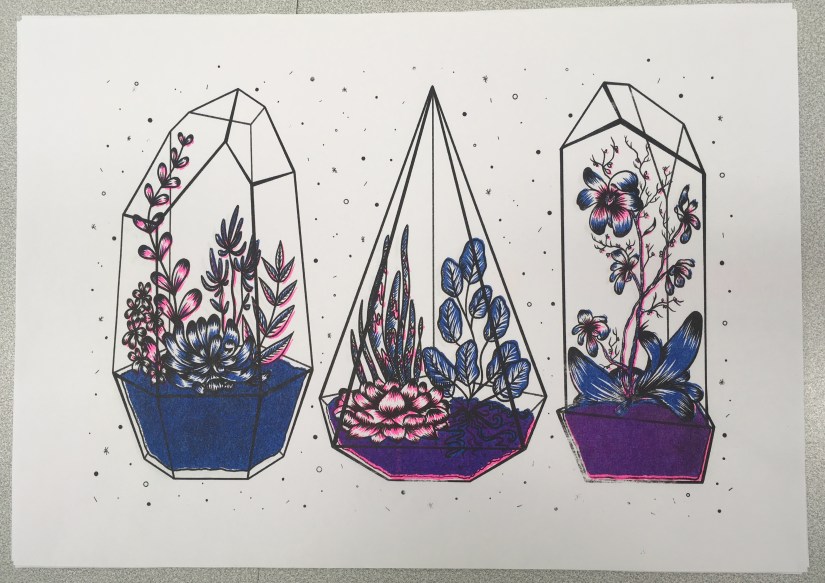
I’ve gone into much further detail about the print process in my development file, but here’s a pic of the final prints:

IMG_8014.jpg
Terrariums Final Print (Collingwood, 2018).

I was actually really pleasantly surprised at how nicely the image printed- although the registration isn’t perfect (which is a common trait of riso printing), the layers blended well and weren’t as messy looking as they appeared on screen.

At this point, I didn’t love my colour palette but I didn’t hate it, either- I’m most likely going to do another run next week, with neater colour layers and a more considered colour palette. Having green ink available will be really helpful!

…But at the same time, I don’t want this project to drag on for too long, since I want to really focus on the Animation Development brief I’m doing (this is especially important, as it will directly influence the Animation project in Semester 2… if the Semester 1 portion isn’t successful, I won’t have a solid foundation to work on!)

Also still to print is the mini A4 photography based geode flash sheet I’m doing as a side project ♥


References

Collingwood, C. (2018). Risograph Digital Ink Layers: Blue, Black, Pink [Digital].

Collingwood, C. (2018). Terrariums [Risograph print].

inspiration, research

November Update – Reflection and Target Setting

It’s been a wee while since I wrote the last post… it’s been a weird few weeks with only a little bit of progress unfortunately! I’ll hopefully be back into the swing of things now, with updates at least once weekly.

In terms of the riso project, I’ve finished everything bar the actual printing of the artwork… so yes, I’m slightly behind. I’ll correct this during this coming weeks while I work alongside the Character Design Development project so I don’t fall behind- I can’t afford to lose any project time this year.

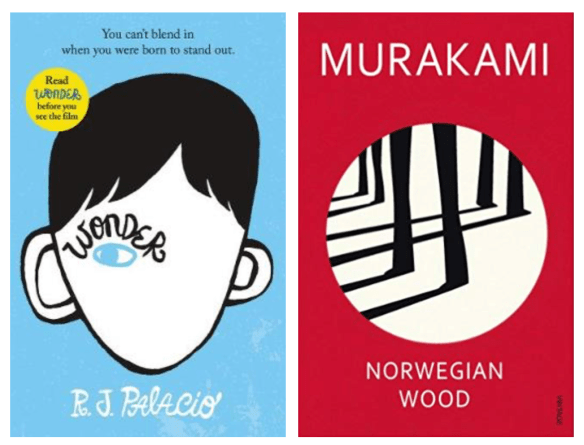
Additionally, the list of book titles for the Penguin Student Award has been released- initially I was torn between Wonder by R.J. Palacio, and Norwegian Wood by Haruki Murakami. The current iterations of the cover art for both titles are very minimal and follow a specific theme throughout the rest of the author’s novels. Below are the two most recent covers released in the UK:

Screen Shot 2018-11-12 at 11.27.42.png
Left: Palacio, 2014. Right: Murakami, 1987.

Ultimately, I’m marginally more partial to Wonder, especially as I think some of the key imagery and thematic elements that are featured in the narrative lend themselves towards my style and interests slightly more than Norwegian Wood. More on this next month when I start production on the project~

I’m also due to start my Character Design/Animation Development project this month- I’ll do an update soon about my initial research and where I’m going with the characters and storyline. This is a project that I’ve had in mind for *years*, so it’ll be nice to finally bring it into realisation ♥

It’s been a rough few weeks but I’m excited for what lies ahead and for the upcoming projects I’ll be working on- but for now, I’ll be mostly focusing on finishing the riso project (e.g. doing some initial test prints while we wait for the new ink colours to arrive)- at present I’m in the dark as to what the test prints will yield. It could be that I’ll have to completely re-do my artwork, or alter some of the design, or a number of other things. I’m worried about it, but I’m also too excited to start the next project so my mind is all over the place! Hopefully I’ll be able to have some closure with the riso project soon.

Targets for the following month include finishing the riso project very soon (in order to leave ample time for the other two projects), as well as continuing to promote ‘radial thinking’ in my process, particularly as part of the experimental nature of Semester 1.


References

Palacio, R. (2014). Wonder. London: Corgi. p. Cover Artwork.

Murakami, H. (1987). Norwegian Wood. London: Vintage. p. Cover Artwork.

research

Risograph Research

It’s now the third week of my timetabled period in which I’m meant to be working on the Printmaking project; while the work I’ve produced in the past 2 weeks isn’t completely irrelevant, it’s high time I started getting deeper into the risograph side of things, e.g. how it works, the process and how to create artwork suitable for the riso.

Dare I say… from the research I’ve done so far, it actually sounds easier than I’d initially anticipated. An actual miracle.

From what I’ve gathered, risograph printing is essentially a cross between screen printing and photocopying, but more environmentally friendly and with a more limited colour range (MUCH more on this in my project research- I’m just doing a quick recap).

Having said that, it’s still quite technical and very different from the processes I’m used to working with. For example, you have to keep in mind the bleed areas around the design, the potential for accidental overlap, and the possibility of errors due to the machine, e.g. roller marks. However, through careful planning I’m certain a lot of these areas of concern can be sidestepped- respectively, this could be through careful border layout, trapping line and colour, and laying out heavily inked areas accordingly. (HatoPress.net, n.d.).

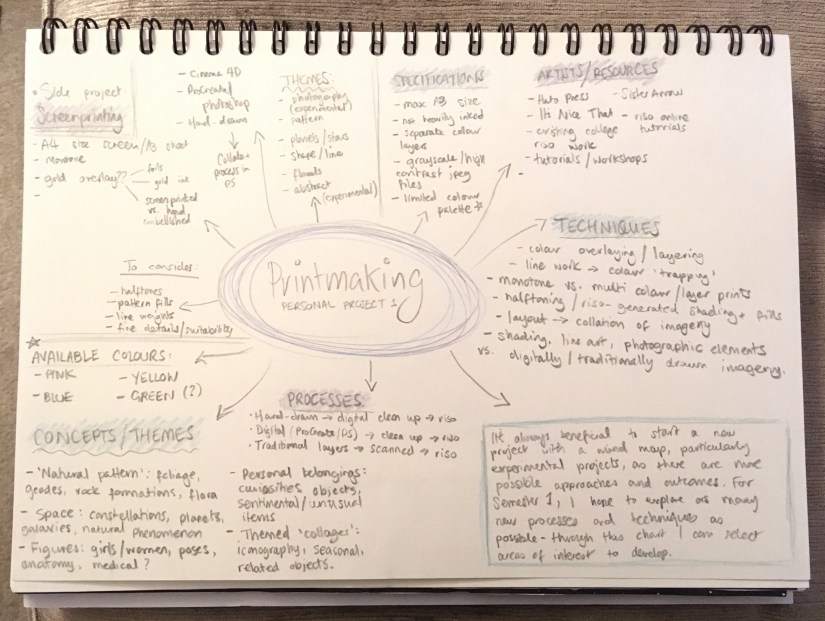
It’s quite a lot to keep in mind, but doing an ample amount of research prior to designing imagery has given me a really good basis of knowledge on which to build the project. My initial mind map helps me to plan out the work I need to do as the project progresses:

IMG_7945.jpg
Initial Mind Map- I find these useful at the start of every project. (Collingwood, 2018.)

Pending the success of this introductory project, I could utilise this technique to make zines, posters, business cards etc for final show- the colour palette might be more limited, but it’s infinitely less laborious than screen printing (and most of the other traditional printing processes, for that matter)~


References

Collingwood, C. (2018). Personal Project 1 – Initial Mind Map.

HatoPress.net. (n.d.). Printing – Risograph. [online] Available at: https://hatopress.net/printing/#guide-item-1 [Accessed 22 Oct. 2018].